Ultralights: Personal Aircraft You Can Fly With No License
Can you fly a personal aircraft with no license?
Yes, if it qualifies as an ultralight under FAR Part 103. A personal aircraft with no license required must have no airworthiness certificate, carry a single occupant for sport or recreation, and weigh less than 254 pounds with under 5 gallons of fuel if powered. Top speed is capped at 55 knots. Ultralights fly only in day VFR, stay away from congested areas, and need ATC permission to enter controlled airspace.
In this article I’ll cover exactly what airplanes you can fly without a pilot license.
Love aviation but not sure you want to go through the time and expense of getting your pilot’s license? Believe it or not, there is a class of airplanes you can own and fly without one—ultralights.
Ultralights aren’t the biggest or fastest planes in the sky. Actually, come to think about it, they are literally the smallest and slowest. But that doesn’t mean they aren’t a ton of fun. Plus, they’re a great way to fly and own a plane for a fraction of the cost.
Here’s a look at the world of ultralight flying.
What Is an Ultralight Airplane?
An ultralight is an aircraft that falls under FAA FAR Part 103. A powered ultralight has no airworthiness certificate, carries one occupant for sport or recreation, weighs under 254 pounds, and holds under 5 gallons of fuel.
Technically, an ultralight is an aircraft that falls under the FAA’s FAR (Federal Aviation Regulation) Part 103. The rule allows for airplanes, gliders, and even rotorcraft so long as they meet a few simple requirements.
To be considered an ultralight aircraft it must:
- Not have an airworthiness certificate
- Be for a single occupant and used for sport or recreation only
- Weigh less than 254 pounds and hold less than 5 gallons of fuel (powered) or 155 pounds (unpowered)
- Not have a max speed more than 55 knots nor a stall speed more than 24 knots (powered)
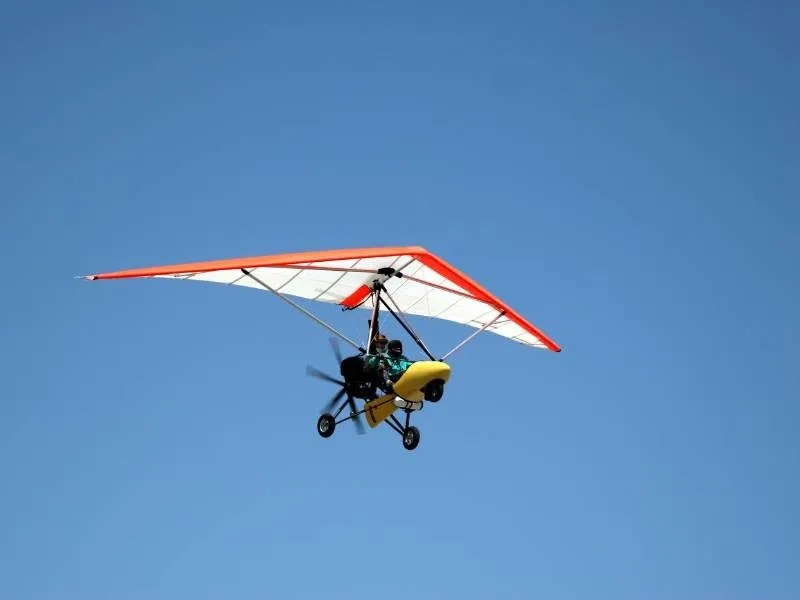
Are There Any Other Limitations on Ultralight Pilots?
Yes, ultralight pilots must follow Part 103 operating rules. Ultralights may fly only in day VFR conditions, never over congested areas, and not in Class A, B, C, D, or E airspace without ATC permission.
Part 103 also outlines some general rules and guidelines for the pilots operating these vehicles. While they do not need to meet the knowledge and experience requirements to get a pilot’s license, they do need to follow some basic rules of the road. Ultralights can only be operated in day VFR conditions.
Ultralights are not allowed to be operated over congested areas like towns. They are also not allowed in controlled airspace (Class A, B, C, D, or E) unless they have permission from ATC. As a result, you’ll find most ultralights stick close to their home airports. And those airports are often rural, uncontrolled fields far out of town.
Ultralights vs. Light Sport Aircraft
A Light Sport Aircraft weighs over 254 pounds or carries more than one occupant, so the FAA regulates it as an aircraft. Flying an LSA requires a pilot's license, but only a Sport Pilot Certificate.
If a plane weighs over 254 pounds or has more than one occupant, then it is considered a Light Sport Aircraft (LSA).
These planes are regulated as aircraft by the FAA, so you need a pilot’s license to operate them. But the FAA makes it easy because you only need a Sport Pilot Certificate to do so.
The Sport Pilot license is the FAA’s newest license. It’s designed for people who just want to fly for fun in small two-seat aircraft near their home airport.
It requires fewer hours of training, so it’s cheaper and easier to get than the Private Pilot license. Ultralights also don’t generally have the same aircraft lights of traditional aircraft.
One of the most popular light sport aircraft is the SportCruiser.
Popular Ultralight Aircraft Models
So, those are the specifics. But what do these aircraft look like, and how do you get one?
Many ultralights are sold as kits that the owners complete on their own. The amount of work depends entirely on the make and model.
Some are sold only as plans, where the owners must fabricate all the parts and do all the work from scratch. Others are sold to be quicker and easier to build, with all the parts ready to be assembled.
This is just a small sampling of the various ultralights out there. There are many types of ultralights flying, but the primary options are powered fixed wings, powered parachutes, rotorcraft, trikes, lighter-than-air, and unpowered gliders.
One great resource for researching and learning more about ultralights is the Experimental Aircraft Association (EAA).
Aerolite 103
The Aerolite 103 is the epitome of ultralight planes.
You can buy one fully assembled and read-to-fly or as a quick-build kit that you can assemble in less than 50 hours. You can get a number of different engine options, from 28 to 63 horsepower or even electric, and tons of options are available to make your Aerolite your own.
Prices for the kit start at about $23,000, while the fully assembled planes start at about $28,000.
The plane is a single-seat, high-wind, fabric-on-frame airplane with tricycle landing gear and a pusher engine. The fuselage is mostly open, with a simple windscreen and nose fairing to keep you out of the wind.
Quicksilver MX103
The Quicksilver MX103 is a Quicksilver aircraft with a fully open cockpit and a strut fuselage, similar to the Aerolite. Fully assembled MX103 versions cost as little as $18,000.
Quicksilver sells several ready-to-fly LSAs and build-to-fly kits. The Quicksilver MX103 is similar to the Aerolite in several ways but has a completely open cockpit and strut fuselage.
It’s also slightly cheaper, with fully assembled versions as low as $18,000.
Kolb Firefly
The Kolb Firefly is another open-cockpit high-wing, but its fuselage includes a solid tail boom and metal airframe. The Kolb has folding wings for storage and a partial windscreen.
The Firefly quick-build kits start at $17,270, plus the engine.
Hummel Ultracruiser
The Hummel Ultracruiser is an all-metal ultralight with detachable wings that looks like a traditional airplane. The build kit costs $28,442 without the engine, and a ready-to-fly Ultracruiser starts at $37,292.
Here’s an ultralight that looks and feels a little more like a traditional airplane. The Hummel Ultracruiser is all metal and looks sleek. The wings detach for easy transport and storage. You can buy the plans or as a parts kit.
The lightning-quick build kit costs $28,442 but doesn’t include the engine. A ready-to-fly Ultracruiser starts at $37,292.
Weight-Shift-Controlled Ultralight Planes
Weight-shift-controlled ultralights include Powered Parachutes (PPCs) and Powered Paragliders (PPGs), the two most common types. Both get lift from a large parachute-like canopy and rank among the least expensive aircraft for private owners.
There are quite a few weight-shift-controlled ultralights out there. The two most common are Powered Parachutes (PPCs) and Powered Paragliders (PPGs).
PPCs have an engine mounted on a frame, which includes a cockpit and basic tricycle landing gear. Not all PPCs are ultralights—some have two seats and more power than are allowed under Part 103.
PPGs, on the other hand, usually have no frame at all. The engine is mounted on a backpack that the pilot wears, and they are launched and land on foot.
In both cases, lift is achieved via a large parachute-like canopy that can be packed away when you’re done.
These types of ultralights represent some of the least expensive and most accessible types of aircraft for private owners.
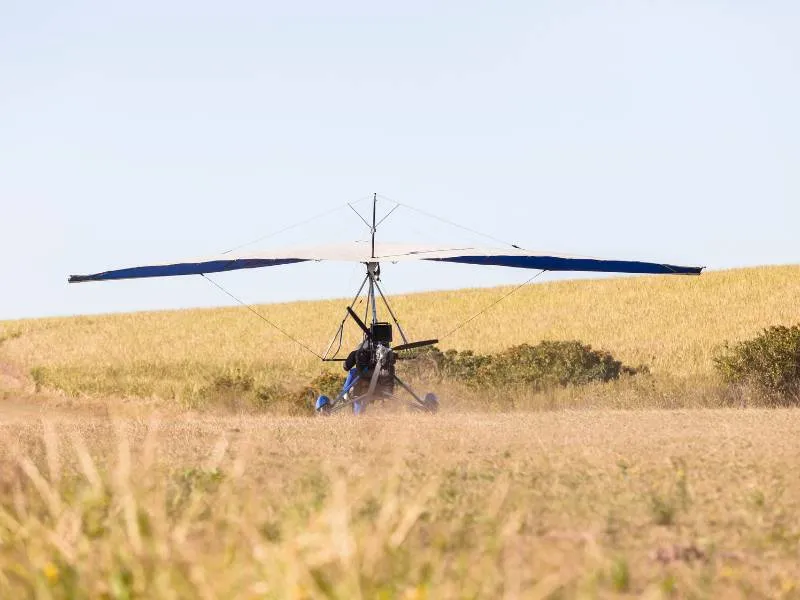
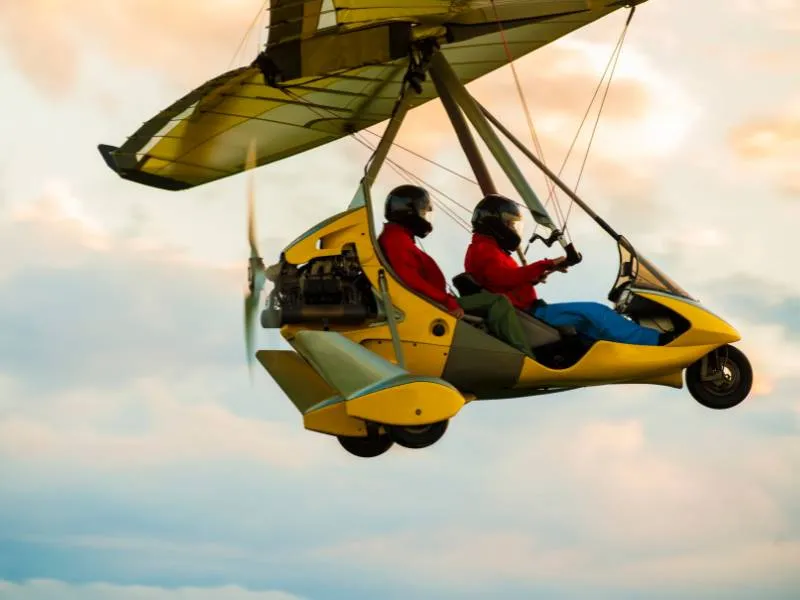
A variation is to have a rigid skin-on-frame wing instead of a chute, like a hang glider.
Like PPCs and PPGs, powered hang gliders can be open with only a backpack-mounted motor (called foot-launched powered hang gliders or FLPHGs) or “trikes” with frames, seats, and motors.