
Degree
BS, Flight Education
If a degree matters — to you, to your family, or to the restricted ATP minimums — you do not have to choose between it and flying. Hampton University students take aviation coursework on campus and fly with our instructors fifteen minutes away.
Hampton students earn a Bachelor of Science in Flight Education through the School of Engineering, Architecture and Aviation, accredited by the Aviation Accreditation Board International. Thrust Flight is the authorised flight training provider.
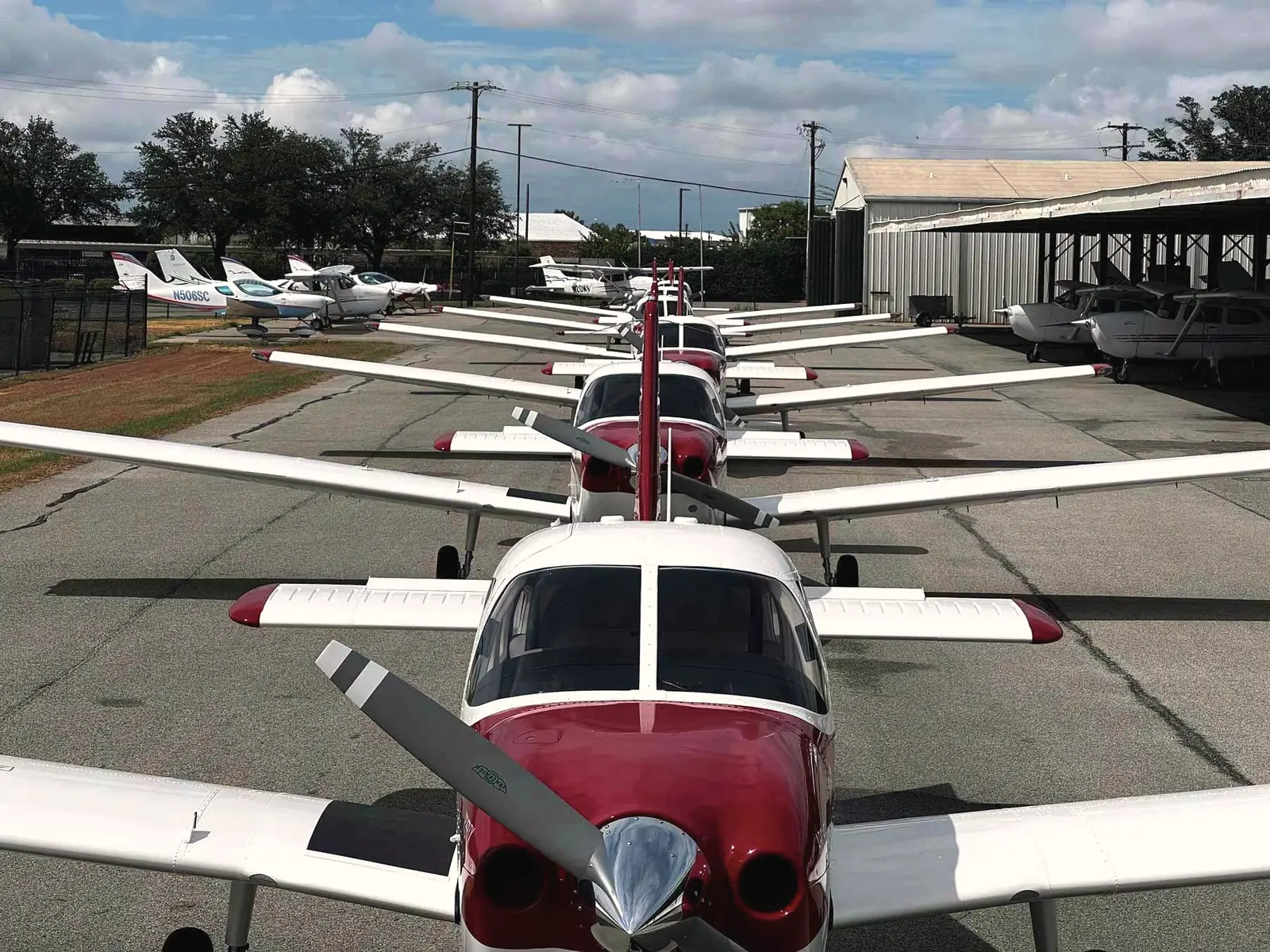
Academic work happens on Hampton’s campus. Flying happens at Newport News/Williamsburg International, about fifteen minutes away, with our instructors, in the same Piper Archer TX and Piper Seminole fleet we run everywhere else — and with the same examining authority, so checkrides are scheduled on the field rather than around an outside examiner.
The flight sequence is the full professional one: private, instrument, commercial, multi-engine, CFI and CFI instrument. Roughly twenty-four months from first lesson to flight instructor, weather and progress permitting.
Two bills, not one. Hampton bills tuition, room, board and academic fees. Thrust bills flight training directly. It is worth understanding that split before you start, because the two do not arrive on the same schedule. Run the numbers.
In 1939 the federal government set up the Civilian Pilot Training Program, and Hampton Institute was one of only six historically black colleges chosen to run it. Between 1939 and 1942 it trained 175 pilots.
Several of them went to Tuskegee. Roscoe Draper earned his certificate at Hampton in 1940 and went on to instruct more than nine hundred airmen there; he died in 2024 at a hundred and five. Edward A. Gibbs, a civilian flight instructor at Tuskegee, later founded Negro Airmen International.
We are the flight training provider on a program with that behind it. It is worth knowing whose runway you are on.
For the airlines, sometimes and specifically: a qualifying aviation degree can lower the ATP minimum from 1,500 hours to 1,000 or 1,100, which is months off the front of a career. Whether a particular degree qualifies is a question for the school awarding it, not for us.
For everything else, it is the ordinary argument for a degree, and it is a real one. A medical certificate can be lost, and a pilot who cannot fly and has nothing else is in a worse position than one who can do something else.
If none of that applies to you, the direct program is faster and cheaper, and we will say so.
Worth a look.