Can You Be a Pilot If You Are Color Blind?

Can you be a pilot if you are color blind?
Yes, in many cases you can be a pilot if you are color blind. Since January 1, 2025, the FAA screens new pilots with one of three approved computer-based tests: the CAD test, the Rabin Cone Test, or the Waggoner Computerized Color Vision Test. You can take any or all of them, with no limit on attempts. If you can't pass any of them, your AME can still issue a third-class medical limited to day VFR, and you can appeal to the Federal Air Surgeon for a first- or second-class medical. The military offers no such options.
In this post we’re going to answer a frequently asked question, can pilots be colorblind.
Pilots need to identify different colors to fly successfully. Therefore, pilots are tested for their color perception when they see an Aviation Medical Examiner (AME) for a medical certificate.
Your AME will give you a color blindness test. If you fail that colorblind test, it’s not necessarily the end of your flying career. You can try the other FAA-approved color vision tests, and if you still don’t pass, you can ask the FAA to review your color vision limitation.
But understanding why the FAA is strict about these rules–and who they let fly and who they do not–are important considerations if you’re pursuing a long-term career as a professional pilot.
Why Being “Color Normal” is Important
The FAA wants to make sure that pilots can clearly and easily identify different colored lights. For example, when flying night approaches, pilots must identify white, green, red, yellow, and blue lights.
Think about the VASI/PAPI lights or airport beacons, which require the pilot to differentiate the color of a light in absence of any other clue. This is unlike driving a car, where street light designs clue you into the color without needing to see the color.
Further, airport lights are often tiny specks of light far away. A pilot with color deficiency will have a difficult time differentiating these faint clues. It’s also worth noting that these deficiencies become much harder to deal with in difficult conditions, such as when fatigue plays a role.
Identifying different colored lights helps pilots identify the correct runways and taxiways. Pilots must also identify approach lights and ILS lights for instrument approaches.
And, of course, they should be able to see different colored lights in the cockpit and read charts that use magenta, green, and blue shading.

A pilot that misinterprets lights while flying an approach at night could endanger the safety of their crew, passengers, and people on the ground. The FAA is focused on safety and wants to ensure that pilots can perceive different colors used in aviation operations.
Color blindness rules were given a fresh review following an accident involving a FedEx 727 in 2002. The color deficient first officer, flying a night approach into Tallahassee Regional Airport, sank below the glide path on a visual approach.
The aircraft crashed one half-mile short of the runway into trees and broke apart. The first officer’s inability to interpret the VASI lights on the night approach was cited as one probable cause in the NTSB’s accident report.
Color Perception Issues
According to AOPA, about .5 percent of women and eight percent of men have difficulty with color perception. Most color perception difficulties arise from deciphering between red and green.
Updated 2025 Color Vision Standards
Before 2025, AMEs could choose from many different color vision tests, and pilots who failed them usually proved their color vision through an operational color vision test with the FAA. The FAA says those older tests were poorly standardized and that some AMEs were giving them incorrectly.
Effective January 1, 2025, the FAA requires an approved computer-based color vision test for pilot medical exams. The FAA also cites the growth of color cockpit displays and an NTSB safety recommendation as reasons for the change.
Color vision is now a one-time screening. If you already passed any previously FAA-approved color vision test, you don’t need to retest, and the FAA still recognizes existing Letters of Evidence (LOE) and Statements of Demonstrated Ability (SODA).
Color Vision Testing
Color vision testing for pilots is done by an Aviation Medical Examiner (AME) during the medical certificate exam, usually with an Ishihara test. The Ishihara test hides a number inside a pattern of small colored circles.
When you see an Aviation Medical Examiner (AME) for a medical certificate, the AME will give you a colorblind test to ascertain your color perception. Since January 1, 2025, this must be one of the FAA’s approved computer-based tests, taken in person.
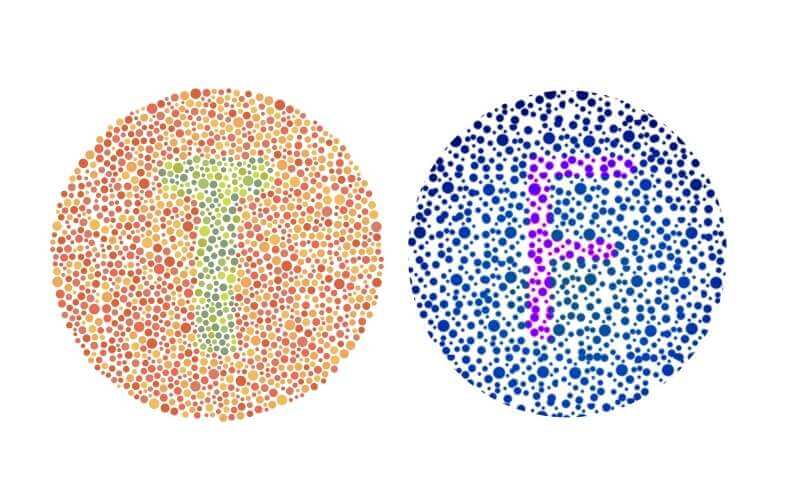
Before 2025, many AMEs used the Ishihara test, which hides a number inside a pattern of colored dots. The FAA no longer accepts plate tests like the Ishihara for pilots, and any test the FAA does not specifically list is not acceptable.
The computer-based tests are randomized, so you can take a test more than once or switch to a different approved test if you fail one. Tests taken at home, virtual tests, downloaded or printed versions, and free trial versions are not accepted.
If You Think You May be Color Deficient
Pilot candidates who suspect a color deficiency should book a consultation with a local AME before scheduling the actual medical exam. The AME can run several color tests in the office and help build a game plan.
If you think you may be color deficient, schedule a consultation with a local AME BEFORE scheduling an actual medical exam.
Not every AME has one of the approved computer-based tests, so ask ahead of time. If your AME doesn’t have one, you can take the test at another clinic, and that clinic must give your AME the color vision printout with your scores.
Can You Fly If You Fail the Color Test?
If you fail a color vision test, you can still become a pilot. If you can’t pass any of the approved tests, the AME can issue a third-class medical certificate with the limitation “Valid for day visual flight rules (VFR) only.”

Before you accept that limitation, try the other approved tests. The FAA lets you take any or all of the three computer-based tests, and failing one does not stop you from trying another. If you test somewhere other than your AME’s office, the provider must be able to verify your identity and give the AME your score report.
If you pass any of the approved tests, you don’t need a limitation, LOE, or SODA for any class of medical, and the AME can issue the class you applied for if you are otherwise qualified.
Color Vision Tests Accepted by the FAA
Since January 1, 2025, these are the only color vision tests the FAA accepts for pilots:
- Colour Assessment & Diagnosis (CAD) test, Environment and Aviation (Commercial) version
- Rabin Cone Test (RCCT), Air Force/Army/Navy/Coast Guard version
- Waggoner Computerized Color Vision Test, Adult Diagnostic or FAA version
Third Class Medical Options
Third-class medical applicants who fail color perception tests can ask the FAA for an Operational Color Vision Test (OCVT). In the OCVT, an FAA safety inspector checks that you can tell colors apart on a navigation chart and identify signal lights.
If you can’t pass any approved test, the AME should not defer your application. If you are otherwise qualified, you’ll receive a third-class medical with limitation #104, “Valid for day visual flight rules (VFR) only.” If you already hold a third-class SODA or LOE and want to keep a third-class medical, you don’t need a computer test, and your certificate can be issued with no color vision limitation.
First and Second Class Medicals
First and second-class medical applicants with color deficiency must pass both the OCVT and a color vision Medical Flight Test (MFT). Pilots complete the OCVT and MFT only once, then receive a letter of evidence and a medical certificate.
If you fail all of the approved computer tests, there is no direct path to a first- or second-class medical. Instead, you can appeal to the Federal Air Surgeon by having your AME submit a Color Vision Limitation Review along with your test results. The FAA reviews these requests case by case and may ask for more information.
Before 2025, pilots in this situation took an Operational Color Vision Test (OCVT) and a color vision Medical Flight Test (MFT) to earn an LOE or SODA. If you already hold a first- or second-class LOE or SODA, you don’t need a computer test, and the AME can issue your first- or second-class medical with no color vision limitation.
If you hold a third-class SODA or LOE and want to upgrade to first or second class, you must take one of the approved computer-based tests. If you pass, no limitation is required. If you fail, you’ll get a third-class medical limited to day VFR and can appeal to the Federal Air Surgeon. The FAA says one goal of the new tests is to reduce the need for OCVTs, which are time-consuming and expensive.
Color Vision and Military Pilots
No, applicants who fail the military color vision tests cannot become military pilots. The Air Force, Navy and Army use the Contrast Cone Test, PIP and Farnsworth Lantern tests, and the military offers no field test options like the FAA.
If you want to fly in the Air Force, Navy, or Army, you must pass a color vision test. The military gives pilots a Contrast Cone Test (CCT) to test blue, red, and green color vision. In addition, the military uses the PIP and Farnsworth Lantern test to test color perception.
If you fail the color vision tests, you won’t be able to become a military pilot. The military doesn’t have field test options as the FAA does. If you are interested in becoming a military pilot and worried about your color vision, see an optometrist and ask for color vision testing.
If you aren’t eligible to be a military pilot, you may still be able to pursue a career in civilian aviation by passing one of the FAA’s approved color vision tests or having your limitation reviewed by the FAA.

Color Correction Options
Many products aim to help people perceive more colors. However, the FAA does not allow pilots to wear color-correcting sunglasses or lenses.
Final Thoughts
Yes, color-blind people can still become pilots if they prove they can identify light signals, airport and airplane lights, read aeronautical charts, and interpret terrain and obstacles. An optometrist can test color perception early.
If you are just starting in your aviation career and worried about your color vision, see an optometrist and ask for color perception testing.
If you don’t pass the FAA’s computer-based color vision tests, you can still fly during the day with a third-class medical limited to day VFR. Flying at night, when you depend on runway and airplane lights, and earning a first- or second-class medical require passing an approved test or a successful review by the Federal Air Surgeon.