Learn Airplane Parts & Their Function in Our Essential Guide
The anatomy of an airplane is complex, with each component meticulously designed for safety, efficiency, and performance.
In this article we’ll go over all of the major airplane parts every pilot needs to master.
Below we’ve included images showing the parts of an airplane you need to know.
Throughout this article we’ll stick to the basic parts of a plane. As you go through your pilot training you’ll learn more about each of these parts and go deeper into what makes up all of these components.
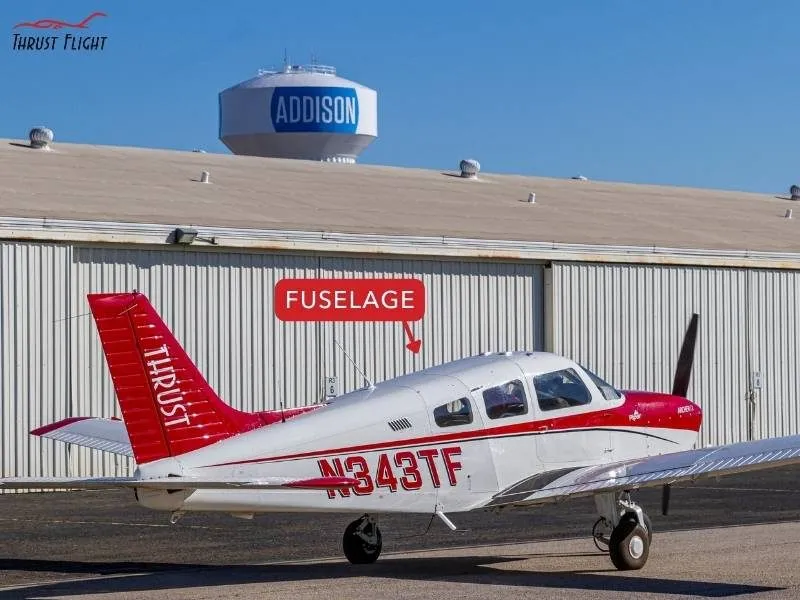
Fuselage
The fuselage is the central body of an airplane and the main structure that all other parts attach to. The fuselage houses the cockpit, passengers and cargo, and bears the stresses of flight.
The fuselage is the central body of an airplane and a principal structure to which all other airplane parts are attached.
It is the enclosed part of an airplane that houses the cockpit, passengers, and cargo.
Not just a container, the fuselage is integral to the structural integrity of the aircraft, contributing to its overall aerodynamics and stability.
It’s the fuselage on a plane that bears the stresses of flight and, in the case of pressurized cabins, maintains a life-sustaining environment at high altitudes.
Wings
Airplane wings are the structures that provide lift and control for flight. Wings carry several key parts, including ailerons, flaps, slats and spoilers, each with a specific role.
Wings are a crucial part of an airplane, designed to provide the necessary lift and control for flight.
They are composed of various components that contribute to their overall function. Let’s look at some key airplane parts of the wing and their specific roles.
Ailerons
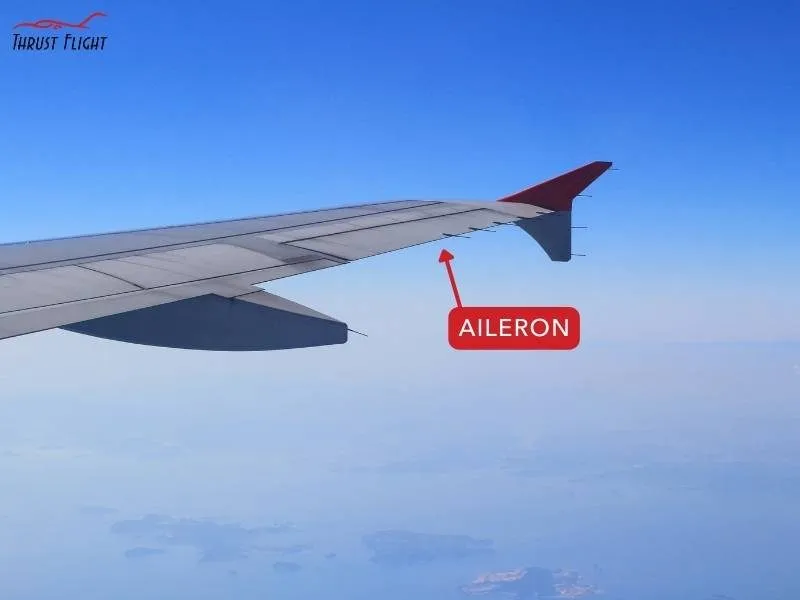
Ailerons are moving surfaces on the trailing edge of the wing near the wingtips. Ailerons control the airplane's roll, which lets the pilot turn or stabilize the aircraft.
Ailerons are the moving parts found at the trailing edge of the wing, near the wingtips. They control the airplane’s roll motion, allowing the pilot to make turns or stabilize the aircraft.
When the right aileron moves up, it increases the lift on that side, making the right wing rise and causing the plane to bank left, and vice versa.
Flaps
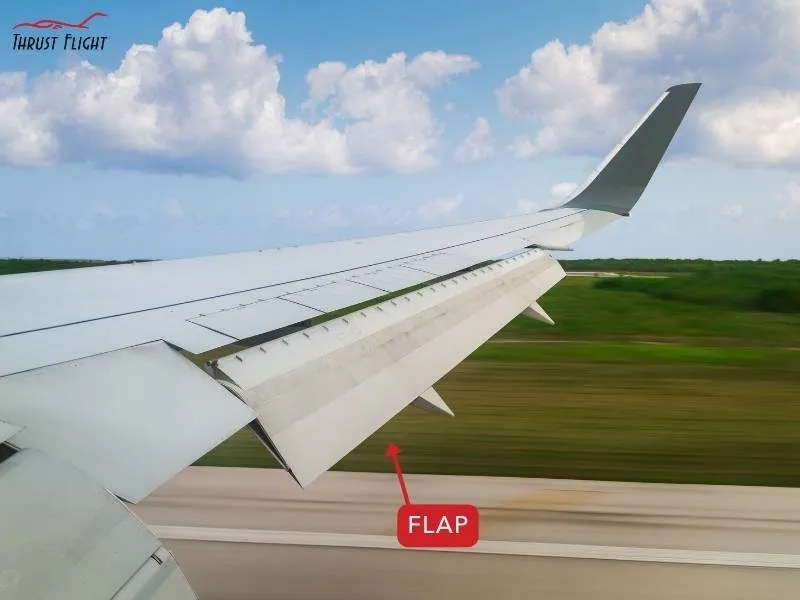
Flaps are devices on the trailing edge of the wing, next to the ailerons. Extended flaps increase lift or reduce speed, which makes them most useful during takeoff and landing.
Flaps are located on the trailing edge of the wings, adjacent to the ailerons.
These devices can be extended to increase the lift or decrease the speed of an aircraft. Flaps are particularly useful during takeoff and landing, allowing for a steeper ascent or descent without an increase in airspeed.
Winglets
Winglets are the small, vertical fins at the tips of the wings. They improve an aircraft’s efficiency by reducing drag, specifically vortex drag, which occurs at the wingtips as the airplane moves through the air.
Slats
Slats are devices on the leading edge of the wing. Deployed slats increase the wing's surface area and curvature, which gives more lift at lower speeds during takeoff and slow maneuvering.
Slats are similar to flaps, but they’re situated on the leading edge of the wing.
They are deployed to increase the wing’s surface area and curvature. This change allows for higher lift at lower speeds, which is crucial during takeoff and when maneuvering at slower velocities.
Spoilers
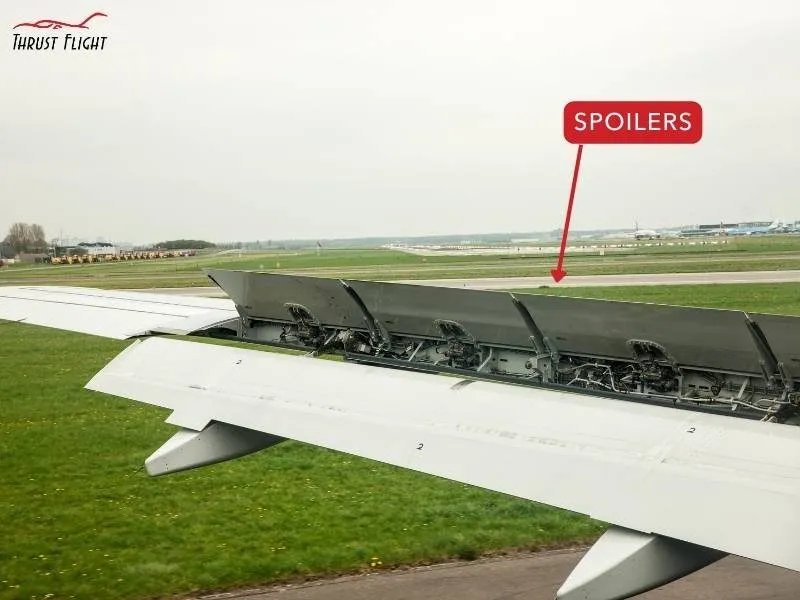
Spoilers are rectangular panels on the top of the wing that disrupt airflow, reduce lift and increase drag. Pilots use spoilers for roll control and to slow down or descend faster. Deployed together, spoilers act as air brakes.
Spoilers are rectangular panels found on the upper surface of the wing designed to disrupt the airflow over the wing, reducing lift and increasing drag. They are primarily used for roll control and to help the airplane slow down or descend more rapidly.
When deployed symmetrically, spoilers can also act as air brakes, useful during descent and landing.
Tail (Empennage)
The tail section, or empennage, of an airplane provides stability and control. It consists of several components, each with a specific aerodynamic function.
Horizontal Stabilizer and Elevator
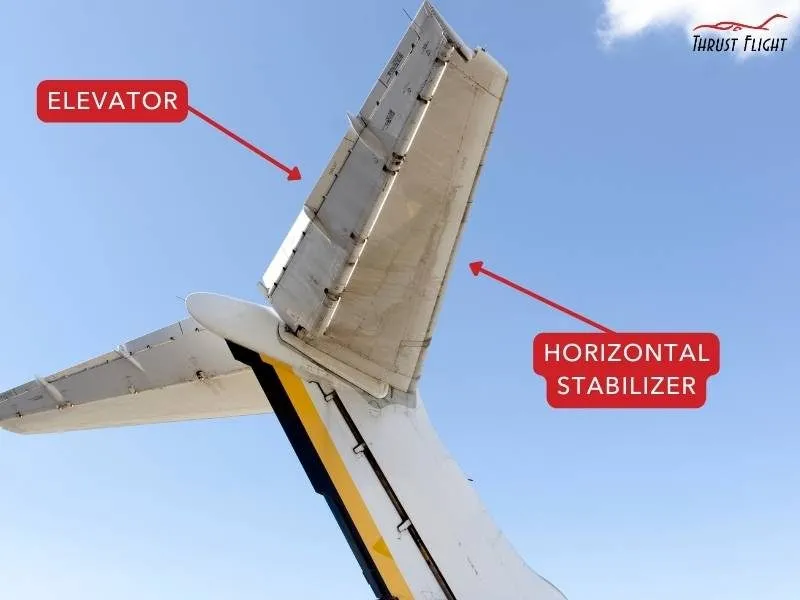
The horizontal stabilizer is the tail surface that keeps the airplane stable in pitch. The elevator is the movable surface on its trailing edge that raises or lowers the nose.
The horizontal stabilizer maintains the aircraft’s pitch stability. It serves to counteract the pitching moment generated by the wings and helps balance the airplane in flight.
Connected to the trailing edge of the horizontal stabilizer is the elevator. This movable control surface is responsible for changing the airplane’s pitch attitude.
By manipulating the elevator, you can make the aircraft’s nose go up or down. In flight, you might adjust the elevator to ascend, descend or maintain level flight.
There are several different styles of horizontal stabilizers and elevators. You can learn more in our article on elevators.
Vertical Stabilizer and Rudder
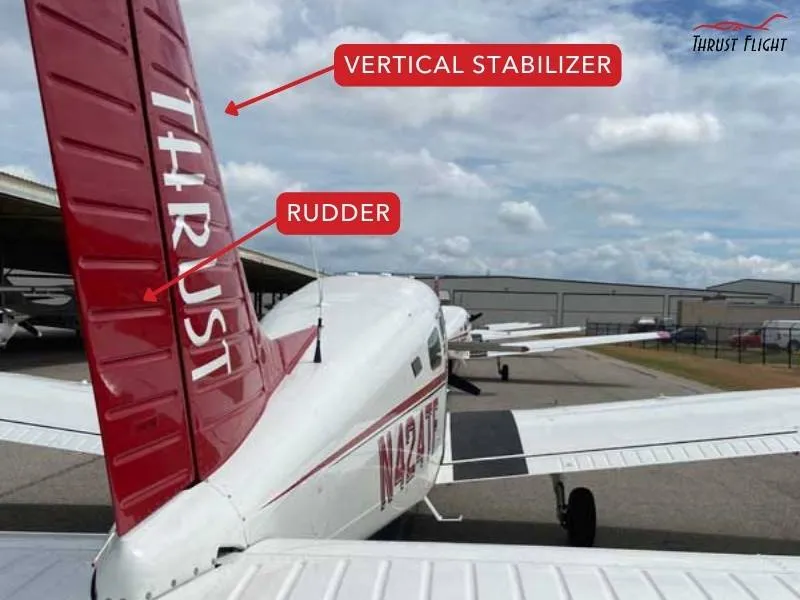
Similar to the horizontal stabilizer, the vertical stabilizer is a fixed surface positioned vertically at the rear of the airplane.
Its main function is to provide yaw stability, ensuring the aircraft remains stable while moving left or right.
Attached to the rear edge of the vertical stabilizer is the rudder. This movable control surface allows you to change the airplane’s yaw, or its orientation to the left or right.
Just as the elevators control pitch, the rudder is responsible for turning the aircraft when needed.
Engine(s)
An airplane engine is the part that provides power and thrust to move the aircraft through the air. Aircraft engines fall into two broad groups: piston engines and gas turbines.
The engine provides the necessary power and thrust to propel an aircraft through the air.
There are different types of engines that power airplanes, and they can be broadly classified into piston engines and gas turbines.
In this section, we will discuss the main types of aircraft engines and their functions.
Piston Engines
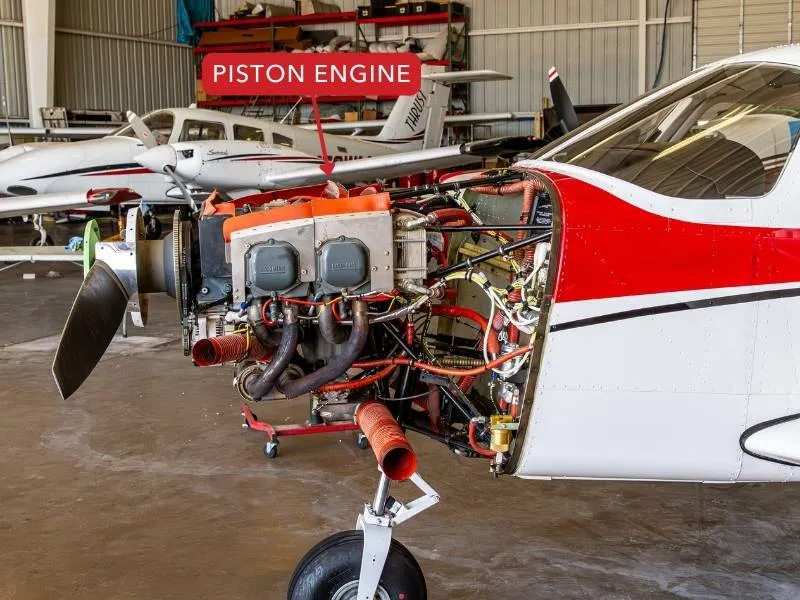
Piston engines are the engines used in most smaller general aviation aircraft. Piston engines work like car engines, igniting a compressed fuel-air mixture with a spark plug and turning a crankshaft that drives a propeller.
Piston engines are commonly found in smaller, general aviation aircraft.
They function similarly to automobile engines, converting fuel and air into mechanical energy by compressing a fuel-air mixture in a cylinder and igniting it with a spark plug.
The resulting expansion of gases pushes against a piston, moving it up and down. This motion is then transferred through a crankshaft to the propulsion system – typically a propeller.
Piston engines can be fuel-efficient and are simple to maintain.
Turbine Engines
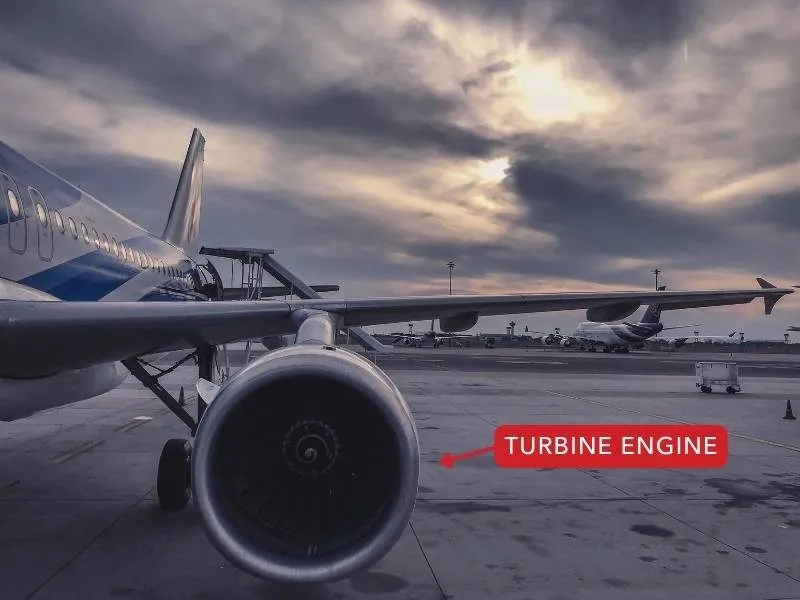
Turbine engines, also called gas turbines or jet engines, power most modern commercial and military aircraft. Turbine engines compress air, mix it with fuel and ignite it. Types include turbojets, turbofans and turboprops.
Gas turbines, also known as jet engines or turbine engines, are used in most modern commercial and military aircraft.
They create thrust by compressing and heating air, which is combined with fuel and ignited in a combustion chamber. The resulting high-temperature, high-pressure gases then expand and exit the engine at very high speeds, generating thrust.
Gas turbines come in various types, including turbojets, turbofans, and turboprops.
Propeller
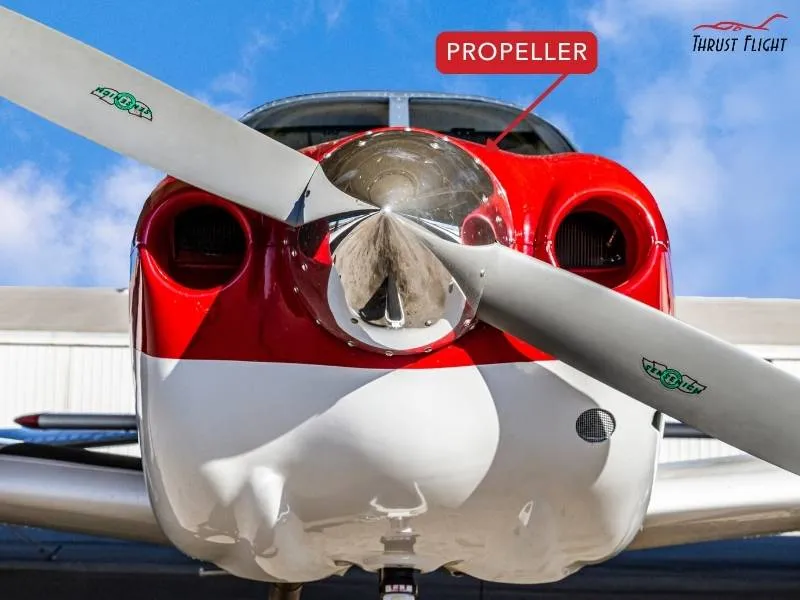
A propeller is a rotating airfoil that turns engine power into forward thrust. Propellers create a pressure difference that pulls the airplane forward, and their behavior affects takeoff, cruise and landing performance.
Linked directly to the engines in propeller-driven aircraft, propellers function as rotating airfoils that convert rotational energy into linear thrust.
They slice through the air, creating a pressure difference that propels the airplane forward.
There are nuances to propeller mechanics that pilots must understand as they affect takeoff, cruising, and landing performance.
Landing Gear
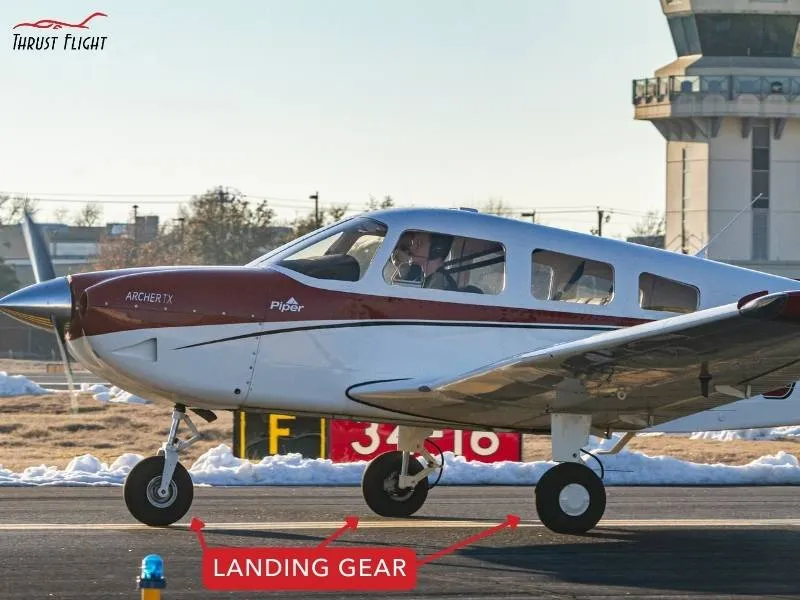
Landing gear is the set of wheels, floats or skis that supports an aircraft during takeoff, landing and ground operations. Most small aircraft, such as the Piper Archer and Cessna 172, have fixed landing gear.
The landing gear is responsible for supporting the aircraft during takeoff, landing, and ground operations. They consist of a combination of wheels, floats, or skis, depending on the aircraft type and its specific requirements.
During takeoff and landing, the wheels absorb the impact forces and make ground operations smoother. These wheels are often constructed with advanced materials to withstand the immense pressure and wear they experience during regular usage.
In some instances, like when landing on water, other types of landing gear, such as floats, are required. Floats are designed to enable aircraft to land and take off from water surfaces, making them essential for seaplanes and amphibious aircraft.
Skis, on the other hand, are another type of specialized landing gear used for aircraft that need to take off and land on snow or ice.
During flight, the landing gear is usually retracted to reduce drag and enhance fuel efficiency.
This process involves various hydraulic or electrical operations, ensuring safe and efficient movement of the gear. Most small aircraft such as the Piper Archer or Cessna 172 don’t have retractable landing gear.
Airplane Cockpit
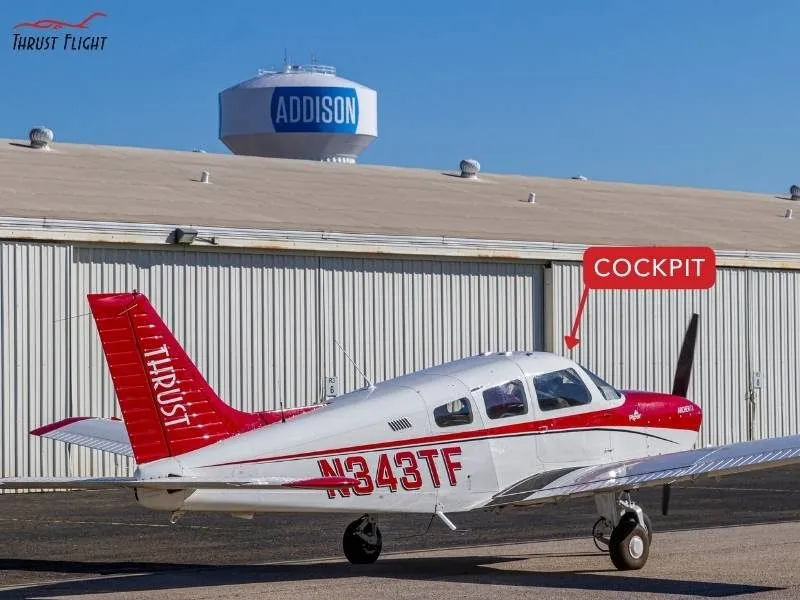
The cockpit is the command center of any airplane, and it houses all the essential equipment needed for the pilot to operate the aircraft safely.
In this section, we’ll explore the various airplane parts found in the cockpit.
Instrument Panel
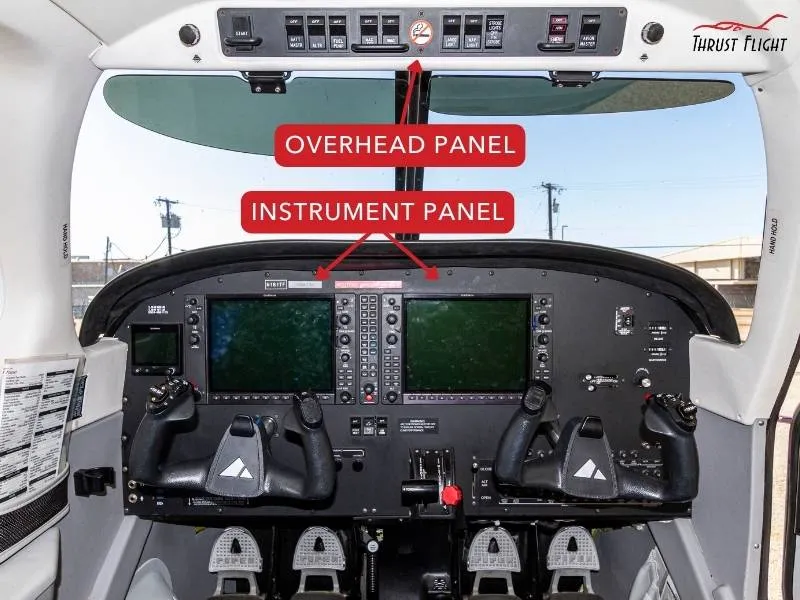
The instrument panel is the cockpit panel of gauges and displays that shows the pilot flight information, such as altitude, speed and position. Modern glass panels combine these readings on digital displays like the Garmin G1000.
The instrument panel in a plane cockpit holds a number of gauges and displays providing vital flight information to the pilot. It includes altimeters, speed indicators, and navigation aids, among others.
Modern cockpits are equipped with glass panels that integrate these readings into digital multi-function displays such as the Garmin G1000.
Overhead Panel
The overhead panel in a cockpit houses controls for various aircraft systems such as electrical, fuel, hydraulics, and environmental controls. Exactly what controls are located in the overhead panel will vary across aircraft.
Flight Controls
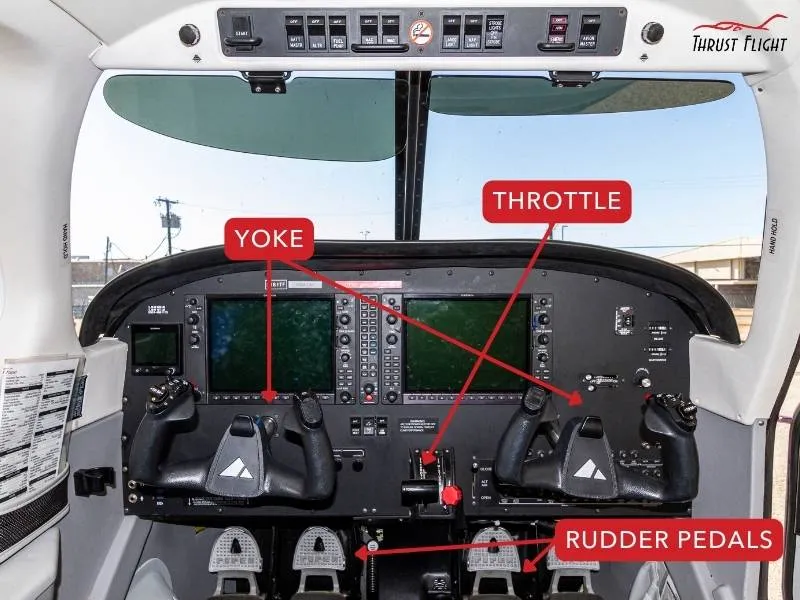
The main cockpit flight controls are the yoke or stick, the rudder pedals and the throttle. The yoke controls pitch and roll, the pedals control the rudder, and the throttle sets engine power.
The main flight controls in the cockpit are the control yoke or stick, rudder pedals, and throttle.
These allow the pilot to adjust the airplane’s control surfaces (aileron, rudder, and elevator) to manipulate the aircraft’s movement.
- Yoke or Stick: This control is used to maneuver the ailerons and elevator, enabling the pilot to control the plane’s pitch (up and down) and roll (left and right).
- Rudder Pedals: Located on the cockpit floor, these pedals control the rudder, which helps steer the airplane, particularly during taxiing and coordinating turns.
- Throttle: The throttle regulates the engine power, determining the airplane’s speed and climb rate.
Rudder Pedals
As mentioned earlier, rudder pedals are located on the cockpit floor and are used by the pilot to control the aircraft’s yaw.
They help the pilot maintain directional control, especially during takeoff, landing, and taxiing.
Pilot Seats
Pilot seats in the cockpit are designed for comfort and functionality.
They are adjustable to ensure that pilots have the proper line of sight and reach to all controls, which is essential during different phases of flight.
Side Consoles
Side consoles are panels on either side of the pilot that hold extra instruments and controls. Not every airplane has side consoles. When present, side consoles may include trim controls and avionics switches.
Side consoles are situated on both sides of the pilot and house various instruments and controls. While not installed in all airplanes, when they may include items such as trim controls and avionics switches.
These components are essential for managing the aircraft’s performance during takeoff, landing, and other critical flight phases.