A TOMATO FLAMES | FLAPS | GRAB CARD D
What does A TOMATO FLAMES stand for?
A TOMATO FLAMES is a mnemonic for the equipment FAR Part 91.205 requires for VFR day flight: airspeed indicator, tachometer, oil pressure gauge, magnetic compass, altimeter, temperature gauge for liquid-cooled engines, oil temperature gauge for air-cooled engines, fuel gauges, landing gear position indicator, anti-collision light, manifold pressure gauge, ELT and safety gear. For night VFR you add FLAPS, and IFR flight adds GRAB CARD D on top of both.
In this article we’ll cover easy ways to remember an aircraft’s required equipment.
When learning to fly, the question often arises: what would you do if this were broken or inoperative? It’s just one of the many “what if” questions instructors love throwing at their students. Knowing the answer means you have studied and know a lot about your plane and the Federal Aviation Regulations.
So, how do you begin to learn it all? Here’s a simple way to memorize some of the most important items on an aircraft—the things that absolutely must be working before you take off.
FAR Part 91.205 — Instrument and Equipment Requirements.
FAR Part 91.205 lists the instruments and equipment an aircraft must have working to be legal to fly. Pilots remember the VFR day list with the mnemonic A TOMATO FLAMES, and extra equipment appears in the POH/AFM or MMEL.
Part 91.205 lists what an aircraft must have working to be legal. It’s not an all-inclusive list because your plane might have some things extra. If it does, they’ll be listed in the Limitations chapter of the POH/AFM or on the Manufacturer’s Master Minimum Equipment List (MMEL).
But this list is a starting point. An easy way to remember everything on the list is with the mnemonic A TOMATO FLAMES.
What Does A TOMATO FLAMES Mean? Required Equipment for VFR Day Flight
A TOMATO FLAMES is a mnemonic for the equipment FAR Part 91.205 requires for VFR day flight. The letters stand for items such as the tachometer, oil pressure gauge, anti-collision light, ELT and safety belts.
A – Airspeed indicator
T – Tachometer for each engine
O – Oil pressure for each engine
M – Magnetic compass
A – Altimeter
T – Temperature gauge for each liquid-cooled engine
O – Oil temperature gauge for each air-cooled engine
F – Fuel gauges
L – Landing gear position indicator, if the aircraft has retractable gear
A – Anti-collision light, red or white
M – Manifold pressure gauge for each altitude engine
E – ELT (emergency locator transmitter, if required by FAR Part 91.207)
S – Safety gear, including seat belts and shoulder harness PLUS flotation gear if the flight is operated beyond glide distance from shore
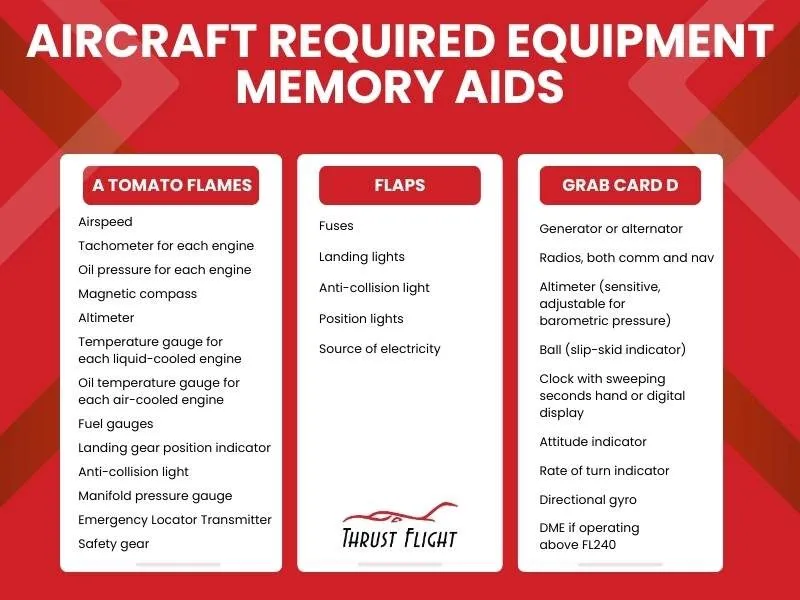
Required Equipment for VFR Night Flight: FLAPS
VFR night flight requires all A TOMATO FLAMES equipment plus the FLAPS items. FLAPS stands for fuses, landing lights (for hire only), anti-collision lights, position lights and a source of electricity such as an alternator.
You need everything from A TOMATO FLAMES plus the FLAPS acronym for VFR night flying.
F – Fuses (one spare set, or three of each kind used; must be accessible to the pilot)
L – Landing lights (only required when operating for hire)
A – Anti-collision light, red or white
P – Position lights (red, green, and white navigation lights)
S – Source of electricity, adequate for all the installed equipment (e.g. the alternator)
Required Equipment for IFR Flight: GRAB CARD D
IFR flight requires A TOMATO FLAMES, FLAPS and GRAB CARD D equipment under FAR Part 91.205. GRAB CARD D covers a generator or alternator, radios, sensitive altimeter, ball, clock, rate of turn indicator and DME above FL240.
IFR flight requires having A TOMATO FLAMES, FLAPS, and GRAB CARD D.
G – Generator or alternator
R – Radios, both comm and nav, appropriate for the flight
A – Altimeter (sensitive, adjustable for barometric pressure)
B – Ball (slip-skid indicator)
C – Clock with a sweeping seconds hand or digital display
A – Attitude indicator
R – Rate of turn indicator
D – Directional gyro
D – DME, if operating above FL240
These lists come from FAR Part 91.205. Read the complete text on ecfr.gov.